Exploding Cucumber on Vine

Exploding Cucumbers! (Cyclanthera explodens)

I don’t normally bother too much with Latin names, but it is important here as there are two plants that are known by the name ‘exploding cucumber’, one, Cyclanthera explodens, the edible one which we will look at today, then there is the poisonous one, which you definitely shouldn’t eat, also know as the squirting cucumber, Latin name Ecballium elaterium. The first one fires its seeds out dry like shrapnel, the second one squirts them out in a gooey stream like a, well, like say a water pistol.

Exploding Cucumber on Vine

Exploding Cucumber on Vine

Both of these are dangerous in their own way. The second one is poisonous and inedible, Continue reading

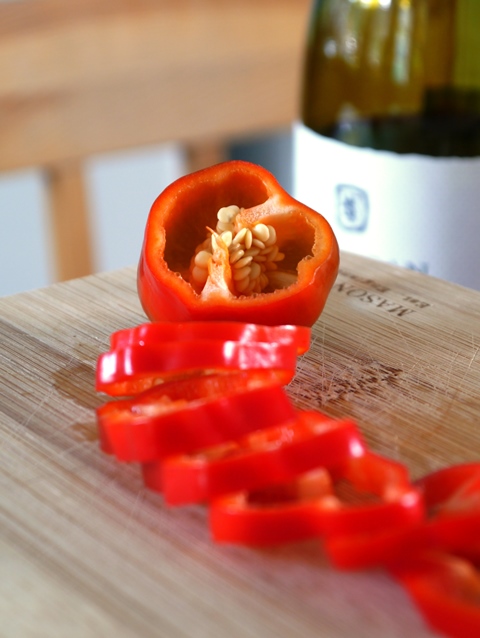
Sliced Cajun Belle Pepper

Cajun Belle

One of the varieties I have grown for the first time this year is Cajun Belle. I wanted a frying pepper, something that I could stuff or chop fairly freely into my cooking that gave a bit of heat, but also acted as a substitute for heat free bell peppers.

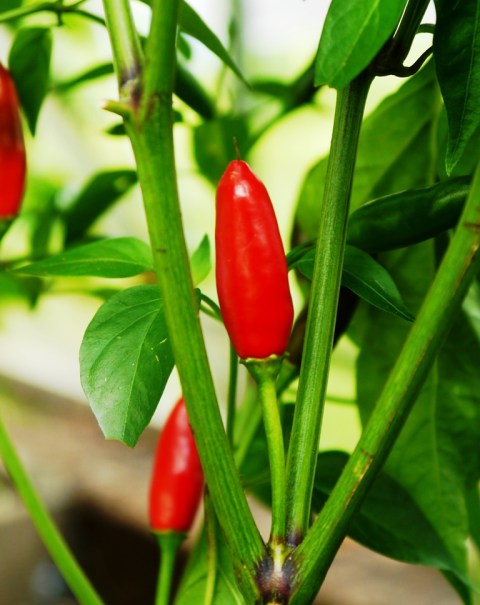
Cajun Belle Peppers

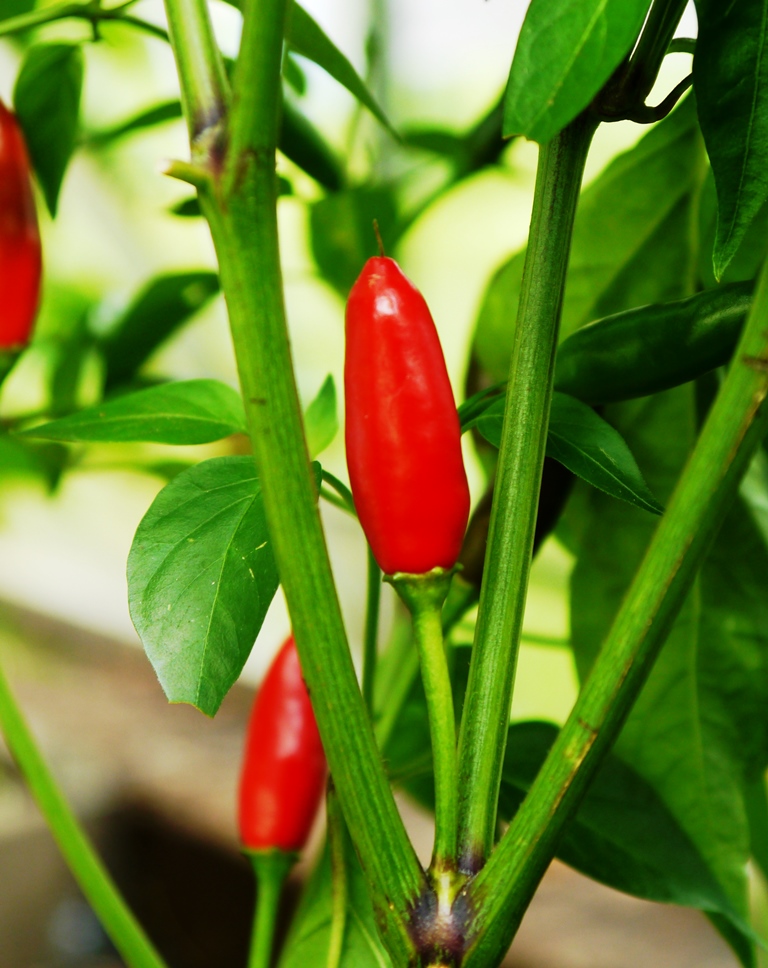
Cajun Belle Peppers

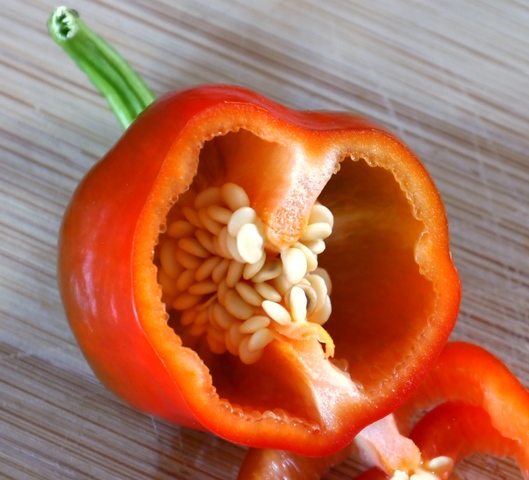
I sampled a few the other day, but today I did the first big pick off of 3 plants. I didn’t pick all of them, only the red ones and a few green. I’d say that currently there is an average of 25 full grown pods on each plant. That is pretty prolific as I’m going to get at least the same again before the year is out. Generally they are 6-8 cm long and 4 cm across so these are really heavy croppers. They look just like mini sweet peppers but quite thin walled and heat-wise they are probably about 3-4000 SHU.

The plants are generally upright and only about 60cm tall, so they are heavily laden with fruit by the time of the first pick and some of the stems need separate support.

Cajun Belle Green

Cajun Belle Green

So my verdict is these are a real winner if this is the type of chilli you want.

  • Quick and easy germination
  • heavy cropper
  • Seed to fruit (green) in 17 weeks (in average greenhouse conditions)
  • Tasty and with a bit of heat
  • Thin walled so the can be easily stuffed

The seeds came from Nicky’s Nursery I would dispute some of the stats on the description there, 61 days to fruit from seed is a bit of a tall order for any chilli. From ‘planting out’ as they say in the USA, maybe, but from seed, I don’t think so, that would have meant picking at the beginning of May for me, which I have never done with any chilli or pepper plant. That said, Cajun Belle is really prolific and I would definitely recommend them, and I will be growing them again next year.

Cajun Belle Chilli Open

Cajun Belle Chilli Open

Piri Piri

My Giant Piri Piri Plant

I have a soft spot for my Piri Piri plants.  I don’t grow everything every year, I  rotate other plants around and If I have a freezer full of something I might miss a year. It gives me a chance to try new varieties and keeps me interested but I will always have my Piri Piri. Partly this is because they are just the best for overwintering, and partly because they crop so amazingly in the second year.

Nobody sells the seed, my seeds come from my mother’s ‘mother plant’. She first collected the seeds about 20 years ago from a garden in Portugal, and has kept them growing ever since, she has a plant about 15 years old, though I have to say it is a bit ropy now. Because she keeps this one growing, and doesn’t grow anything else so the seed she collects is always true. If anyone wants seeds for a plant like mine I can give them some of hers.

As far as I’m concerned this is THE Piri Piri. There are lots of other chillies that look slightly different all over Africa (chillies were taken to Africa from South America by the Portuguese) that are given this name, but that is simply the name they give to a small hot red chilli, so while the name is the same, the chilli might vary. This is made worse by the fact that where chillies are grown for Piri Piri sauce, they tend to choose something that is quick growing and prolific, then brand it with the Piri Piri name afterwards.

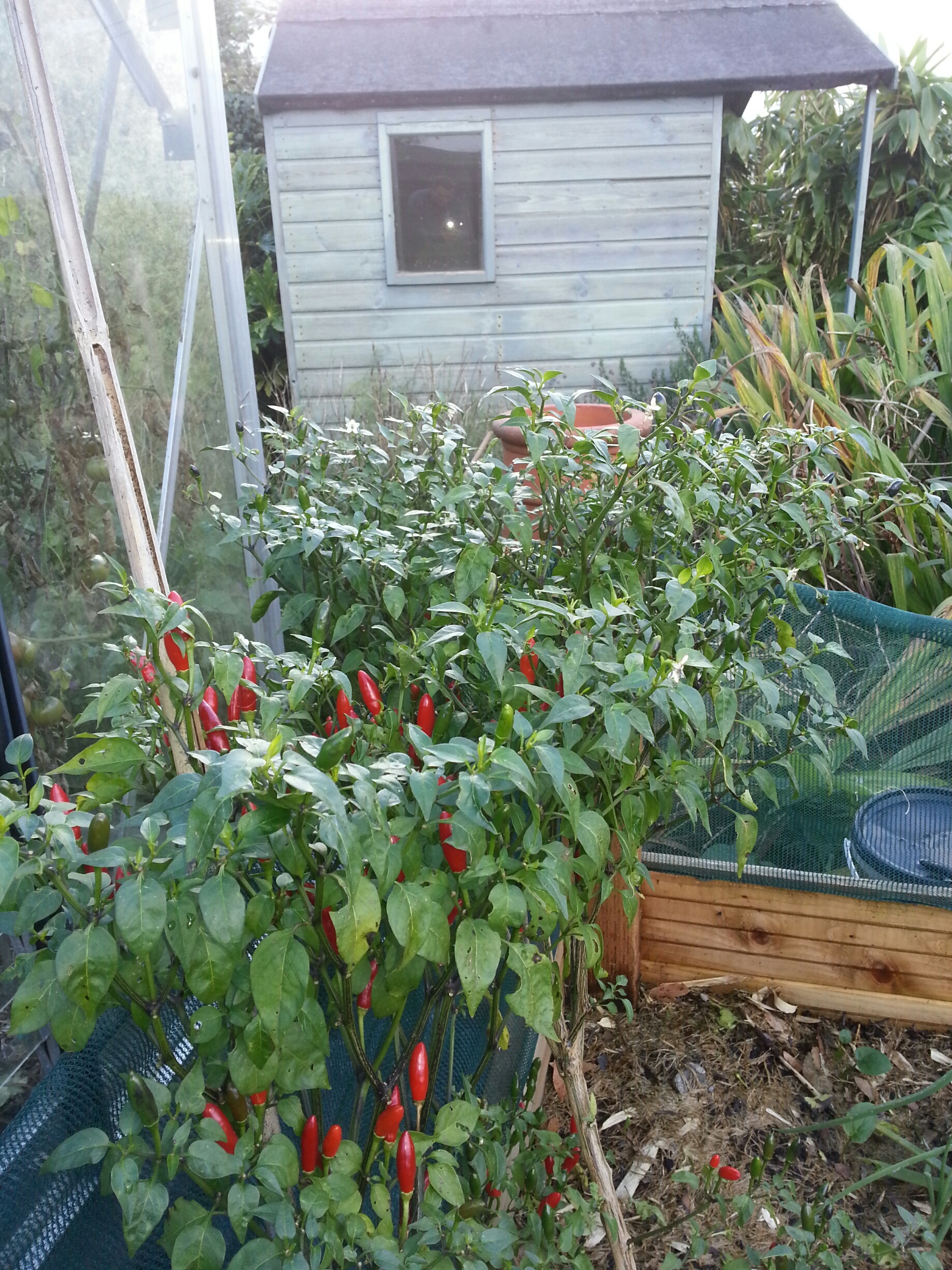
Anyway, back to my plant, the one below is now 5ft (1.5m) tall, and it will get bigger by the end of this year. It is a second year overwintered plant, last year it got to about 4ft (1.2m).

Piri Piri Plant

My 5ft Piri Piri Plant


These are great for overwintering. They are much more tolerant to cold temperatures than most capsicums, they will die back to stems, but this spent a few months last winter in a cool greenhouse with temperatures down to 0°c on a couple of nights. Last winter was a very mild one though (South Devon). Normally I wouldn’t expect plants to survive in the greenhouse, and nothing else that I left in there did.

Also, if frost hits in the autumn this one will survive where others don’t. According to my experiments nothing else will out-survive it apart from the tepin or Chiltepin, which are even more hardy, but pretty useless as a fruiting plant. This one pays dividends everywhere.

Piri Piri Flower

Piri Piri Flower

After winter it lays dormant for longer compared to other types. When I keep other plants they tend to start shooting out very soon after midwinter, and by early February they are shooting nicely. Not with this Piri Piri; maybe because the stems are quite woody, and it is a slow growing plant anyway,  you have to have faith and wait a bit longer, but it will catch up and still fruit earlier than first-year plants.

the chillies you pick will be pretty hot, I recon about 80-100,000 SHU, and off a big plant like this one I am expecting hundreds of them. They will be used for everything, dried, powdered, sauced and pickled.

Piri Piri Green

Piri Piri Green


Piri Piri

Piri Piri


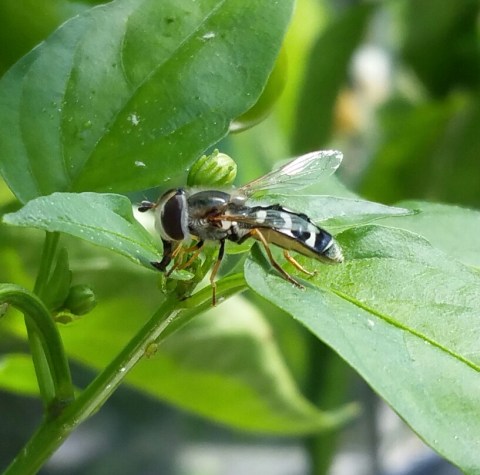
Hoverfly laying eggs on a chilli plant

Hoverflies, Predators of Greenfly

The most commonly talked about predator of greenfly is ladybirds, you can buy them online, or collect them from around the garden, often on stinging nettles, which are themselves riddled with greenfly.

Just as effective, and just as common, if not more so, are hoverflies. The flies themselves usually feed off of plant nectar, but the larvae of many hoverfly species feed on greenfly along with other aphids, thrips and any other small insect they can get their teeth into.

I have a few more greenfly than usual in the greenhouse this year, but today I noticed that the battle has turned against them. I have left the doors wide open in the last few days in the hope that some predators might come in, even at night, which means I risk moths coming in, and that means caterpillars. Sometimes the line between good and bad is a fine one.

I discovered a new way of finding greenfly, just watch where the hover flies go. I have never watched them this closely before.

Update – For a bit more on greenfly detection have a look at this later blog entry.

Hoverfly laying eggs on a chilli plant

Hoverfly on chilli plant

This chappy (chappess actually) hovered around the plants from shoot to shoot, only stopping at the ones which had greenfly in the tips.Here you can see her sucking on a leaf, maybe one that is covered with the sweet sticky dew that the greenfly exude, this is also the stuff that ants love. I couldn’t get a picture of her next move, which was to reach in with her back end and lay an egg among the greenfly. One egg laid, then on to the next shoot. Only the shoots with a greenfly benefited from an egg, so hopefully in a day or two a tiny larvae will emerge on each and start munching. They grow quite quickly so in a few days I will have a picture of one. Watch this space.

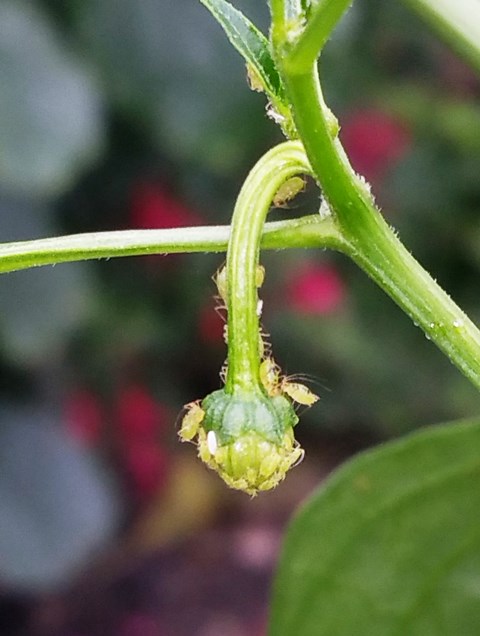
Greenfly on Chilli Flower

Hidden Greenfly Damage

Most people know the common reasons why we shouldn’t let greenfly run amok over our chilli plants, they suck it dry of sap and nutrients and they spread disease. One other big problem with greenfly is that they ruin fruit. Malformed fruit is a fairly common problem on chillies and other factors come into play such as environmental conditions, genetics, and diseases, but problems resulting from greenfly damage are often not credited as such because they occur long after the greenfly have gone.


Greenfly on Chilli Flower

Greenfly on chilli flower

The above picture shows how they enjoy getting their beaks into the soft flesh of a flower, often the flowers and new shoots are the first parts of a plant to be attacked because they are the most tender and succulent. Once this flower opens they will get inside and feed of the reproductive parts of the plant and the tiny chilli before it has even developed. This results in scar tissue from where they pierced the flesh and the outcome is a chilli that is split, or misshaped. You can see this in the picture below.

Greenfly damaged Chilihuacle Negro Chilli

Greenfly damaged Chilihuacle Negro Chilli


Now the Chilhuacle Negro is an odd chilli anyway, the skin is always matt coloured and leathery, even when it is fully ripe (when it turns brown) and it is never smooth and round, but you can see here that secondary fruits have formed close to the calyx (where it joins the stem). On the right hand one these aren’t even closed, they are split open and you can see inside. Whilst still edible, this will probably start to rot before it ripens, and if you were a commercial farmer it certainly wouldn’t be of a quality that you could sell.

The answer to this problem is that as soon as you see evidence of greenfly, usually the feathery white skins on the leaves below, check your flowers. It is difficult to get at the greenfly inside and crush them without damaging the flowers, so you can use an organic spray, but I think it is best to nip off the flowers while they are young so the plant doesn’t waste its resources growing useless fruit. It will soon grow more flowers,usually they produce many more flowers than fruit anyway, and it ensures you get rid of your greenfly and leave the plant producing a healthy crop.

I have had more problems than usual with greenfly this year, but as documented in a previous blog, by far the worst affected have been the Chilhuacle Negros, these fruits must have come from the first flowers be hit, before I even saw them, and I have picked a few fruits like this now. You can never be too diligent!


The Order of Greenfly

I have long been fascinated by the way greenfly will populate one type of chilli plant but not another, and while chilli plants are generally a tasty target, greenfly are happy to dig into one variety while another variety next door goes unscathed, at least for a while.

Some years I get very little in the way of greenfly, other years, like this one they are more of a challenge but even though they are pest, I still find them strangely fascinating. Their breeding cycle is weird, some are born with wings, some without, and some are even born pregnant.

So I have been observing their progress recently. A few weeks ago i noticed a few on my Chilhuacle negro plants, but not any of the others. Now they have spread a bit, firstly to bhut jolokias, but not Carolina reapers, then to some cajun belles, then to some aji, and yet the pimiento de Padron in-between remain untouched.

An entomologist once told me that that they tend to stick to one variety if they can and so in my greenhouse I dispensed with keeping plants of the same variety next to each other, now I alternate them, so that if one plant is infected with greenfly then they are less likely to jump onto the neighbours. Apparently they just get used to the sap of one plant, and their young will prefer to stay there. They still managed to spread from one chilhuacle to another, but it took a while, the fact that they were spread out bought me some time to squash them.

Anyone done any serious experimentation on this?

Slug Eating Chilli

How to REALLY Control Slugs – Drink the Beer yourself, and take the Battle to them

Firstly lets deal with the notion that slugs are just slimy things that whilst annoying to the gardener and not very pleasant, they are otherwise quite innocent.

1/ They will eat the rotting flesh of their dead brothers and sisters, then crawl all over your vegetables

2/ Many of them will eat dog and cat faeces and then they crawl all over your vegetables

Is this what you want?

Now I’m not squeamish about creepy crawlies, but for these reasons alone I don’t touch slugs, well not the big fat ones anyway. There area number of different species and pretty much all of the ones you find in the garden will have a go at your plants and vegetables, but some more than others. Actually the ones that do the most damage on the tender shoots of your peas and beans are more likely to be Common Keeled slugs, or Yellow slugs. The Common Keeled slug is a difficult one to control as it spends most of its life in the soil, and can attack seedlings before they have even emerged into the daylight, you also find them under plant pots where the squeeze into the drain holes during the daytime.

The nasty one is the big fat orangey brown Spanish slug, these are a relatively new invader from overseas, they are drought tolerant, lay twice the number of eggs as native slugs and are voracious eaters of anything and everything, including dog poo and dead animals. They are taking over from our native slugs and are quite a disgusting and unwanted addition to your garden.

You will read about all sorts of ways of controlling and trapping slugs, and you can spend an awful lot of time and money on it too, nasty pellets, eco-friendly pellets, copper bands, plastic traps; the list goes on. All of these take time to set up and inspect, and according to my experience none of them really work. The reason they proliferate is twofold, firstly the people that manufacture things like beer traps and copper bands want to sell you something, and secondly people that offer advice want to do so without causing offence, so they offer tame alternatives to the real way of controlling slugs and snails, which is to hunt them down and kill them, mercilessly, by whatever means you have at hand.

So my slug and snail regime is as follows; I use Nemaslug in the spring, as soon as the soil warms up, (slugs don’t come out until the temperature reaches 6°C). You buy this from online retailers or garden centres and water it all over the garden on a warm moist night. This definitely swings the battle in my favour, and hopefully staves off the population explosion until after the spring rains and into periods of dry soil when slugs lie low anyway. Nemaslug is of particular benefit in the exposed soil of vegetable patches where the damage is done by the soil dwelling Common Keeled slug. The slug that leaving you wondering where they came from and where they go to when the sun comes up. They are the ones that will get your early seedlings and also attack root vegetables and newly germinating seeds underground.

Slug Eating Chilli

Slug Eating Chilli


After Nemaslug there is no substitute for the nightly massacre. This goes for snails as well as slugs, (Nemaslug doesn’t work on snails). I go out an hour after dusk and slash or smash every slug or snail in sight. This is free, and actually takes less time than spreading pellets, or filling beer traps. If you drink the beer you would otherwise waste in their traps then this can help with any guilt that may build up during the slaughter. The death toll can run into the hundreds if you don’t keep on top of it.

If you keep this up you will soon get on top of them, and then from time to time on dry evenings you won’t find any, and you can ease off slightly on your nightly binges.

For some further info on slugs, and a handy identification guide, have a look at www.slugwatch.co.uk 

Aji Chilli Flower November

When will my chilli plants die?

I had set aside this morning to do a little bit of pruning on a handful of plants that I would like to over-winter. In my growing chillies book there is a section on keeping plants over the winter, what temperatures to keep them at, how to prune them and when. But it isn’t an exact science, and very dependent upon autumn temperatures, where you live and where you keep your plants.

Anyway, despite the fact that we are only 5 weeks away from Christmas, the plants I want to keep, which are still in a greenhouse, in south Devon, are all still healthy and don’t yet need any pruning. Having said that, the ones I am keeping are mostly ones that I know will do well, or that I know are worth investing a bit of time and warmth in. So I have a some aji plants, a nice big piri piri, and a whopping great moruga scorpion. There are a few others which have a bit of fruit to ripen, but things like jalapeno, most of my habaneros, pimiento de padron and a few others have mostly been consigned to the compost bin.

So my thoughts turned to which plants would die first if I left them as they are. Which are the most frost tolerant? And some people might be interested in an experiment we conducted at the chilli farm many years ago. With the help of the weather we achieved some fairly accurate and interesting results. In a polytunnel containing 100 varieties we didn’t do the usual autumn cleanup, which is the way it should be done, good garden hygiene, stop the spread of disease, bla bla bla; instead we left the plants in situ, and while the temperature dropped over successive days we observed the results. This was the first cold snap of the year, so to begin with all the plants still had most of their leaves.

As the temperature inside the tunnel dropped towards freezing the first plants to succumb were the tropical ones, Capsicum chinense the habaneros and scotch bonnets, they will lose all their leaves in a single night at 1 or 2°c.

The next night the temperature dropped lower, and hit zero for the first time. At this point the ones to go are the bigger Capsicum annuum big peppers and jalapenos, especially the newer more highly bred ones.

Another day went by and overnight the temperature had reached -1°c. Now looking along the beds it was really evident which ones were survivors and which ones had suffered, but the leafless plants were interspersed with quite a few that still retained their leaves. These were mostly the Capsicum baccatum, tougher leaves and stems, originating from Andean areas where frost tolerance would be an advantage. But also the piri piri, tabasco, and strangely the Prairie Fire were still lookiing good, so the Capsicum frutescens display a lot of frost hardiness too.

Yet another day, and another degree or two of frost, and the only survivor was the tepin, a scrubby bunch of twigs, tiny tough leaves, and a very poor fruiter, but this truly wild chilli out-lived the rest; in fact this very plant lived on for four more years, until a very cold winter brought temperatures of -10°c, and that was the end of it.

So what is to be learned from this? Whatever the ‘rules’ about plant pruning and overwinter temperatures there will always be exceptions. My favourite is the piri piri, always the most loved chillies in my collection. I have said this before, but my mother has the ‘mother plant’ it is the only one she keeps now, so the seed never crosses with anything else, and I always kick off more than I need every spring. There are a lot of varieties under the piri piri banner; this is a Portuguese one, from an old ladies garden, and about midsized as they go, up to about an inch long, and they are solid bullets.

Piri Piri in a Raised Bed, November

Piri Piri in a Raised Bed, November

This picture of Piri Piri plants was taken on 12th November. It sits in a fairly sheltered south facing raised bed, which most importantly gives it good drainage so its roots aren’t sitting in claggy wet soil. The mild autumn temperatures this year do the rest, and it still flourishes albeit slowly, with ripe fruit, new fruit, and flowers.


Big Greenhouse Piri Piri Chilli

Piri Piri in the Greenhouse, November

This plant is the same variety, but inside a greenhouse, it is still going great guns, and might even survive the whole winter at this rate.


Aji Chilli Flower November

Aji Chilli Flower, November

I’m always interested to know what the real survivors are in the chilli world, so if you have any anecdotes or experiences, post them underneath for others to see.

Sliced Poona Kheera Cucumber

Poona Kheera

Sliced Poona Kheera Cucumber

Sliced Poon Kheera Cucumber – This looks a little over ripe, but the seeds are soft and edible, and it is super juicy

A quick post to sate my enthusiasm for something quite humdrum.

I find myself getting excited about a lot of unusual vegetables these days, so here is another ramble about new favourite veg of mine. It is called Poona Kheera and it is an Indian cucumber.

I had few cucumbers rambling around the greenhouse earlier in the year but they were past their best and I thought I would try something different, even though it was quite late in the season. So when I ordered some weird herb seeds from The Real Seed Catalogue I bought some Poona Kheera seeds too.

I’m really really impressed; tasty to the point at which you might confuse them with a ‘not quite sweet enough’ honeydew melon, and really quick growing. The seeds were planted in the middle of July, and after a pretty cool and unimpressive August, the first ones were picked on 10th September, so less than 8 weeks from seed to fruit, pretty amazing.

We chop these into triangles and eat them on their own, more flavoursome even than more traditional varieties, and prolific too.

There you go.

The Poona Kheera Indian cucumber

The Poona Kheera Indian cucumber

Chillies – So what’s with dfferent varieties of the same thing?

Chilli growers hear and talk a lot about different varieties. There are, after all, only 5 main species of chilli and many thousands of varieties within each. But that’s not what I am talking about today. Today I’m dealing with different types of the same chilli, and is it worth paying extra for new and exciting ones, or alternatively spending time seeking out the traditional old ones?

Firstly, I will say that, as a former commercial grower, I think a lot about things like increased yield per plant, uniformity of fruit, and ripening time. But shouldn’t we all? It isn’t necessarily a bad thing; even somebody who only has a single plant in their window would still like to see it produce better, bigger, hotter, quicker or tastier.

So when we go online at the start of the year to shop and dream, we are hit with lots of information. But is the sales patter all true? Phrases like ‘heavy cropper’, ‘bumper yield’, ‘continuous fruiting’ draw us into paying a bit more for a newly developed variety. Conversely, we are also told that looking backwards to old ‘heirloom’ varieties will give us a better flavour, the way things used to be. So is backwards the way forward?

To digress a little, let’s thing about the supermarket tomato. We all know that with tomatoes, what the shops feed us is bigger, quicker and juicier, thinner skinned, but rarely tastier than the ones we grow at home. Tomatoes are grown in such bulk that the growers’ choice of variety has become so influenced by commercial gain that flavour has definitely been sacrificed.

But are chillies affected in the same way? I’m not so sure. Even in areas where they are grown in bulk for a commercial market, increased productivity doesn’t usually lead to a reduction in flavour. Big peppers are different, and they suffer as tomatoes do, but not so much hot chillies.

All these thoughts were prompted by my comparison of two Jalapeno plants last year. They were grown side by side, one was bought as a seedling from a garden centre, grown for an anonymous market at minimum cost. The other grown by me from seed, the variety is ‘Chichimeca’. The results of a comparison are obvious. They both get the same amount of light and plant food, and enjoy the same temperatures, (which were great last summer).

Jalapeno Comparison
This picture has the first few chillies off of the two bushes, the basic Jalapenos are at the top and at the bottom is my favourite variety, Chichimeca.

From an industry insiders point of view, let me explain why the plants the garden centre supply are inferior. This is down to seed price, and the unfortunate fact that the grower of the seedling is so far removed from the eater of the chillies that they have no vested interest in growing something that will be big and bountiful, and this is such a tiny part of the garden centre’s income (compared to the cafe, imported tat, Christmas decorations, BBQs etc. etc.) that they aren’t too bothered either. Basic Jalapeno seed (probably Jalapeno M) will probably cost the wholesale plant grower about fifty quid for 20,000 seeds, so the seed part of their overhead is minimal. New varieties, like Chichimeca might cost them up to a few pence per seed, and suddenly that would have a knock on effect of the price of the seedling they sell to the garden centre, and therein lies the problem. Most garden centres are price-led, so the results aren’t as important.

You will see another illustration of the difference in seed price if you go to a specialist seed seller online. You might find somewhere that sells a wide range of chilli seeds, possibly a range so huge that making your choice becomes a daunting process. These guys will undoubtedly have a few really cheap ‘loss leaders’ they might even give these packets away for free if you buy enough of something else. But is it worth filling your greenhouse with these plants?

I think there are a few varieties where it is worth paying more for something better, greenhouse and window sill space is valuable and shouldn’t be wasted, and our time is valuable too, so we want to make our space as productive as possible, and preferably without too much effort.

So here are a few varieties where you can really benefit greatly by shopping around to find something a bit better.

Jalapeno – Steer clear of anything advertises simply as Jalapeno, Jalapeno M, or Early Jalapeno. These are older varieties, less prolific, and no uniformity of size, which means many will be undersized and lacking in heat where the seeds and placenta inside haven’t formed properly. Instead go for Chichimeca, Ixtapa, Summer Heat, Mucho Nacho, Tula or Mitla.

Orange Habanero – Instead of the standard variety, go for Chichen Itza; it is earlier to ripen, more prolific and bigger.

Serrano – The standard version is slow to grow, and with very few fruits per plant, instead go for ‘Senor Serrano’ They are Longer, more uniform, quicker and hugely prolific.

Ancho/Poblano – The standard plants can be quite rambling and often only the first few off the plant are full size. Instead try the ‘San Martin Hybrid’ it is bigger, more prolific and stronger more compact plants. Beware of hybrid Poblanos that claim huge oversized fruits. There are some crossed with sweet peppers to give a huge fruit, but they start to lose their distinctive flavour if they are bred too big.

And here are some where you can pick up a bargain that is still prolific and worthwhile.

• Hungarian Hot Wax
• Long Slim Cayenne
• Santa Fe