Chillies – So what’s with dfferent varieties of the same thing?

Chilli growers hear and talk a lot about different varieties. There are, after all, only 5 main species of chilli and many thousands of varieties within each. But that’s not what I am talking about today. Today I’m dealing with different types of the same chilli, and is it worth paying extra for new and exciting ones, or alternatively spending time seeking out the traditional old ones?

Firstly, I will say that, as a former commercial grower, I think a lot about things like increased yield per plant, uniformity of fruit, and ripening time. But shouldn’t we all? It isn’t necessarily a bad thing; even somebody who only has a single plant in their window would still like to see it produce better, bigger, hotter, quicker or tastier.

So when we go online at the start of the year to shop and dream, we are hit with lots of information. But is the sales patter all true? Phrases like ‘heavy cropper’, ‘bumper yield’, ‘continuous fruiting’ draw us into paying a bit more for a newly developed variety. Conversely, we are also told that looking backwards to old ‘heirloom’ varieties will give us a better flavour, the way things used to be. So is backwards the way forward?

To digress a little, let’s thing about the supermarket tomato. We all know that with tomatoes, what the shops feed us is bigger, quicker and juicier, thinner skinned, but rarely tastier than the ones we grow at home. Tomatoes are grown in such bulk that the growers’ choice of variety has become so influenced by commercial gain that flavour has definitely been sacrificed.

But are chillies affected in the same way? I’m not so sure. Even in areas where they are grown in bulk for a commercial market, increased productivity doesn’t usually lead to a reduction in flavour. Big peppers are different, and they suffer as tomatoes do, but not so much hot chillies.

All these thoughts were prompted by my comparison of two Jalapeno plants last year. They were grown side by side, one was bought as a seedling from a garden centre, grown for an anonymous market at minimum cost. The other grown by me from seed, the variety is ‘Chichimeca’. The results of a comparison are obvious. They both get the same amount of light and plant food, and enjoy the same temperatures, (which were great last summer).

Jalapeno Comparison
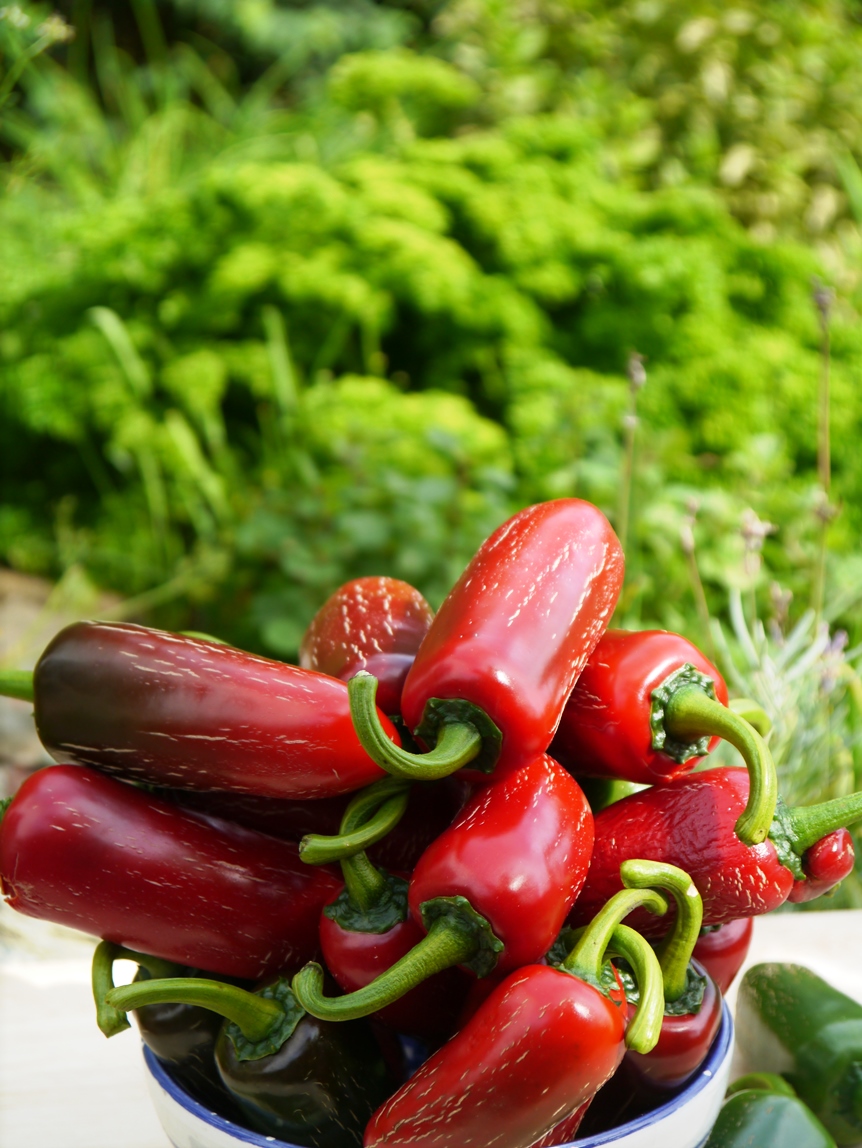
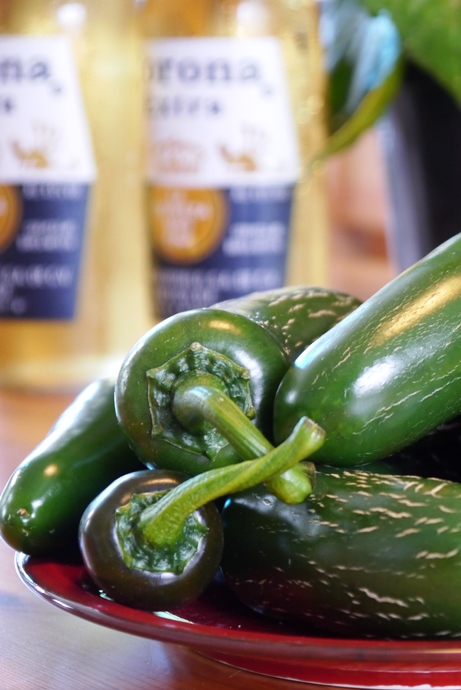
This picture has the first few chillies off of the two bushes, the basic Jalapenos are at the top and at the bottom is my favourite variety, Chichimeca.

From an industry insiders point of view, let me explain why the plants the garden centre supply are inferior. This is down to seed price, and the unfortunate fact that the grower of the seedling is so far removed from the eater of the chillies that they have no vested interest in growing something that will be big and bountiful, and this is such a tiny part of the garden centre’s income (compared to the cafe, imported tat, Christmas decorations, BBQs etc. etc.) that they aren’t too bothered either. Basic Jalapeno seed (probably Jalapeno M) will probably cost the wholesale plant grower about fifty quid for 20,000 seeds, so the seed part of their overhead is minimal. New varieties, like Chichimeca might cost them up to a few pence per seed, and suddenly that would have a knock on effect of the price of the seedling they sell to the garden centre, and therein lies the problem. Most garden centres are price-led, so the results aren’t as important.

You will see another illustration of the difference in seed price if you go to a specialist seed seller online. You might find somewhere that sells a wide range of chilli seeds, possibly a range so huge that making your choice becomes a daunting process. These guys will undoubtedly have a few really cheap ‘loss leaders’ they might even give these packets away for free if you buy enough of something else. But is it worth filling your greenhouse with these plants?

I think there are a few varieties where it is worth paying more for something better, greenhouse and window sill space is valuable and shouldn’t be wasted, and our time is valuable too, so we want to make our space as productive as possible, and preferably without too much effort.

So here are a few varieties where you can really benefit greatly by shopping around to find something a bit better.

Jalapeno – Steer clear of anything advertises simply as Jalapeno, Jalapeno M, or Early Jalapeno. These are older varieties, less prolific, and no uniformity of size, which means many will be undersized and lacking in heat where the seeds and placenta inside haven’t formed properly. Instead go for Chichimeca, Ixtapa, Summer Heat, Mucho Nacho, Tula or Mitla.

Orange Habanero – Instead of the standard variety, go for Chichen Itza; it is earlier to ripen, more prolific and bigger.

Serrano – The standard version is slow to grow, and with very few fruits per plant, instead go for ‘Senor Serrano’ They are Longer, more uniform, quicker and hugely prolific.

Ancho/Poblano – The standard plants can be quite rambling and often only the first few off the plant are full size. Instead try the ‘San Martin Hybrid’ it is bigger, more prolific and stronger more compact plants. Beware of hybrid Poblanos that claim huge oversized fruits. There are some crossed with sweet peppers to give a huge fruit, but they start to lose their distinctive flavour if they are bred too big.

And here are some where you can pick up a bargain that is still prolific and worthwhile.

• Hungarian Hot Wax
• Long Slim Cayenne
• Santa Fe
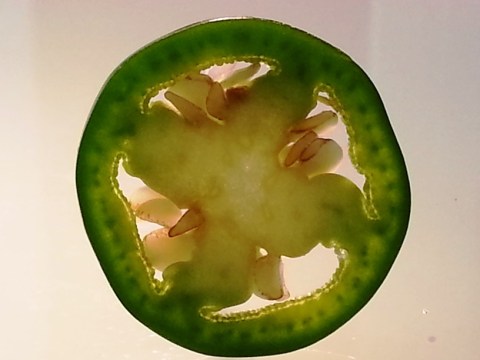
Samsung Galaxy S3 picture of Jalapeno slice.

My Amazing Smartphone Macro Camera

I have long been a fan of my smartphone camera, I remember when I first got it I was amazed by the quality of the pictures generally, but didn’t realise how brilliant the macro setting is.

Smartphone MAcro Yellow Chilli Slice

Samsung Galaxy S3 Macro Chilli Picture

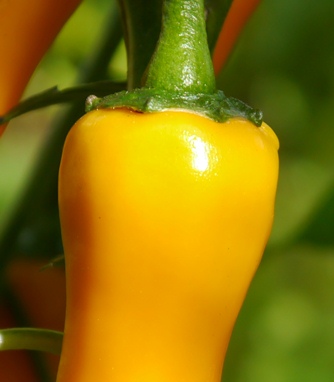
This picture and the one below are back-lit, but the camera is hand-held, such amazing detail. You can pick out the plant cells around the inside of the chilli and see the light shining through the vascular tubes.

Samsung Galaxy S3 picture of Jalapeno slice.

Samsung Galaxy S3 macro picture of Jalapeno slice.

My first and still my most appealing macro picture taken with my phone is quite an old one, and it did such a good job of illustrating how caterpillars munch away on chilli plants that I used it in my book. Again handheld, Samsung Galaxy S3, and with a moving target too.

Caterpillar eating chilli plant

Caterpillar Eating a Chilli Plant, taken with Samsung Galaxy S3 on Macro setting. From the book ‘Growing Chillies’

Fungus Gnats (or Sciarid Flies)

I have never really had a problem with these before, occasionally I have seen them in chilli plants that are overwintered indoors, or other house plants. But mostly they tend to stick to indoor plants with old neglected soil.

For those that don’t know about them, they are a tiny black fly that hangs around the soil in a pot, you often don’t see them until you water it and they all fly up in a panic. Their even tinier grubs will be living in the soil, feeding on algae, rotting organic matter, and according to some experts but not others, the roots of your plant.

This year, however, I seem to have been inundated with them in the greenhouse. I think this is most likely due to the very mild winter. Where I live in South Devon we only had a couple of very light frosts, and the greenhouse never went below zero, hence poor sterilization of the soil. I had a couple of chilli plants out there which developed fungus gnats in their pots but I wasn’t too worried, normally they would die and be discarded before spring. I also had a bag of compost left over from the previous year which had a few in. I didn’t want to use it for potting so I dug it into the beds in the greenhouse. I foolishly thought the flies wouldn’t survive in natural soil because other bugs would kill them off. This was wrong, and before I knew it the beds were crawling, along with some other pots.

I am a big fan of biological controls, Nemaslug etc. and I urge people to use them whenever I can, but it is only recently that I have seen a control for Fungus Gnats. In my Growing Chillies book I deal with Fungus Gnats, but don’t mention a biological control for them as, at the time, there didn’t seem to be one available, hence this update. I have always used the old fashioned method of sticking a piece of potato in the soil which attracts the grubs and can later be discarded. Luckily now there is a biological control widely available, it is inexpensive, easy to use and very effective. It is microscopic nematode worms that infect the fly grubs. It comes as a light powdery substance in a small sealed tray. Dilute it in a watering can and water it into the soil of infected pots. It seems to me that the results are obvious within just a day or two. I suppose the grubs are infected almost immediately and the adults don’t live more than a day or two, so their life cycle is immediately halted.

This will be my first port of call in future, I might even order it as a matter of course every spring when I order my Nemaslug, you can get them shipped together from ‘all good purveyors biological controls’ I use www.greengardener.co.uk 

Do Horticultural Shows Need to Modernise?

I live in a village which holds an annual horticultural show, the likes of which you see in villages and towns all over the UK. Many years ago I used to participate, but when I became a professional grower I wasn’t allowed to compete any longer. Twelve years has passed and as I am now ‘retired’ from professional chilli growing I am eligible to compete again so recently one of the village elders gave me the application booklet, apparently these days they are struggling for participants. Why is this I wonder? With the boom in ‘grow your own’ that can’t have eluded anybody you would have thought there would be lots of eager takers.

Now I am probably not a typical veg grower, I lean towards the unusual, challenging or bizarre. I obviously grow lots of chillies and I don’t have huge amounts of space, so I mostly steer clear of potatoes and the bigger root vegetables. Even so I would say that from what I hear from my humble list of followers, and what I glean from the press, those that have recently taken to veg growing, and in particular younger growers are a little more Thai basil than turnip.

On my local show list there are 32 classes in the vegetable section, and I am currently growing , even if you count chillies as 1, 24 different vegetables or herbs and yet the overlap between the two is only 4, not including the ‘Any other vegetable’ and ‘Any other fruit’ classes. They have runner beans, I grow dwarf french beans, They have turnips, parsnips and beetroot, I have asparagus peas, mouse melons and aubergines. They have marrow, I have squash.

I know of another local show which, when some new organisers took over the reigns, did amend their class list slightly to reflect changes in taste, but this didn’t go down well with the traditionalists. If you have grown prize turnips for decades you might be slightly miffed if your category is culled to make way for’ Hot Pepper’ or ‘Ornamental gourd or squash’. I am interested to know whether anyone has opinions on this, and if so how should horticultural shows reflect changing trends? Some of them go back hundreds of years, with cherished cups presented in memorial to past members, so tradition stands in the way of modernisation. I am inclined to kick things off with an offer of a new cup to my local show for ‘Tropical or Oriental Vegetable’ or some such thing, but would that preclude me from winning it? I’m not too worried.


Pimiento de Padron

Pimiento de Padron, Growing, Picking, Cooking and Eating

I mentioned these in my book, but really they merit a bit more of a shout as they are quite a different thing to grow than your average chilli and well worth trying. In fact they are very addictive to anyone who has tried them. They originate from Spain, where they are popularly eaten as tapas.

There are two fundamental differences between these and pretty much any other chilli you might grow.

1/ They are cooked and eaten whole, and not just individually but by the plateful. They might be a bit hot, or maybe not, but they aren’t really eaten for the pain, just as a tasty snack. Eat everything except the stalk.

2/ They are picked immature and therefore they are quick and easy to grow, and they will continue cropping all season as the plant will keep on producing new fruit quicker than if they were left on the plant to mature.

With regard to cultivating them, they should be treated just as you would any other chilli, but bear in mind that they want to grow big, and I mean up to 5ft tall given the right growing conditions, so put them in a huge pot, or in a greenhouse bed.

If you can get a couple of plants to this size then they will give you a frying pan full every couple of days, but maybe grow 3 or 4 plants just in case. They can go outside in a god summer, like the one we have just had in the UK, but really they need to be in a greenhouse, conservatory or polytunnel.

Picking them – They are picked immature, this means while they are still soft and green, up to about 2 inches long, but don’t be afraid to picke them smaller. If you leave them on the plant they wil grow to about 3 or 4 inches long and get pretty hot, and eventually turn red. The idea is not to let them do this, or the plant will produce less while it puts it’s energies into filling out the bigger fruit.

Cooking them – Toss them around in a hot pan with some olive oil, faff around with them a bit so they don’t get too burnt on one side, but it is fine for them to blacken a bit, that is the idea. A sprinkle of salt is optional, but helps to bring out the flavour. Once they are done, (maybe a bit more than in the photo below). they are ready to eat, but don’t burn yourself by diving in too early.

Tradition says that one in 30 is a hot one. This isn’t a completely random thing though, and you can predict the heat to a certain extent. The heat in a chilli develops when the seeds and placenta, to which the seeds are attached, starts to form. This is where the nack is to picking them. Once they start to become nice and shiny, and become slightly firm, and crunch when you squeeze them, they will have some heat. When they are small and leathery, they won’t. The trick is to pick them at or around this time, you wil soon get the hang of it. In cooler conditions and going into the autumn they will not fill out as quickly, and you might end up with some small ones that are quite hot.

You should get hundreds off of one large bush in a season, so don’t be afraid to keep feeding them, there is no harm in always feeding them whenever you water them. Use liquid chilli plant food or tomato plant food. If the leaves start to turn pale then step up the feeding and you should get a good few months out of them.

You can buy the seeds from a number of the bigger seed merchants, but I have always used the Italian Franchi seeds, you get a lot in a packet.