Aaaaaah – Flatworms!

This is part of my therapy, but I already get the feeling it isn’t going to work.

Warning, this article contains a lot of Flatworm information and a picture; reader beware.

Firstly I will say that I am not usually squeamish about creepy crawlies, in fact from a very early age I have chosen to seek them out. I was a keen amateur entomologist as a young teenager, and still am. I kept giant cockroaches as pets, and have always wanted to know what lies beneath rocks and stones.

Apart from one experience when I opened the lid of the compost heap and momentarily confused half an avocado skin with a giant slug I don’t remember being too repulsed by invertebrates, although a 7 inch giant centipede did run over my foot in Australia once, so I have a bit of a thing about those, and that is fair because they do bite.

One thing, however, that has always sent shivers down my spine is Flatworms, and flatworm-like things in general. Until last week my only experience of such creatures has been horror films, The X Files, and the like, in which they generally cause mayhem beyond what you would expect from the average squishy thing.

Oh, and I don’t like leeches either. There is a pattern emerging here, soft shiny wet things that are wider at one end than the other and move, sometimes quickly.

This therapy isn’t working.

Most gardeners have probably heard of the New Zealand Flatworm but have probably not experienced them, so their knowledge is limited to the fact that they are an unwanted import, they probably came to this country in the pots of imported Tree Ferns, and they are a pest we don’t want or need.

They have been around for a while, taking hold in the great gardens of Cornwall where Tree Ferns and similar plants thrive and Victorian enthusiasts built great collections of imported fora from around the globe.

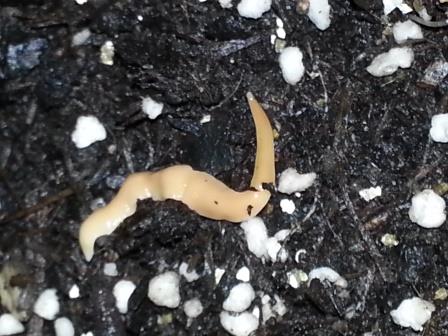
So anyway, last week I was on my nightly slug hunt, the weather has warmed, though still damp and they are emerging ready to do damage. I was mooching round one of my new raised beds, scissors in hand, snipping the odd slug here and there. Suddenly something caught my eye, something out of place, and the beam of my head torch landed on a slippery orangy-yellow thing. I knew what it was instantly, luckily it wasn’t very big, maybe an inch and a half. But I winced and I could feel the blood rushing round my ears. Then there was another one, this time wriggling, wrestling with an earthworm.

This is what they do, they eat earthworms by digesting injecting them with a poison which dissolves their insides and then they suck out the juice.

This therapy definitely isn’t working.

The two worms were each snipped into four pieces, all of them still wriggling quickly. I hope all these 8 parts don’t carry on living, the consequences aren’t worth thinking about.

I took a picture and tweeted it, all the time trying  not to look and I hoped that someone might correct my misdiagnosis, but all I got was confirmation and one lady who put the final nail in the coffin of my Flatworm phobia. ‘They can escape from a sealed jam jar!’

I don’t know for sure if mine are New Zealand Flatworms, I never made a positive identification. I don’t want to look at any more pictures. There are also Australian Flatworms which, I imagine, are slightly larger, a bit more aggressive and in your face, and care a little bit less about the environment around them. I hope, at least, that mine are from New Zealand.

That night I had the worst nightmare I have ever had. A proper ‘you only ever see it in the movies’ type nightmare. I can’t go into the details of it but it involved lots of Flatworms, dozens of them, and huge, much like Indiana Jones in a pit of snakes, and I awoke with a proper scream. My wife thought I was dying.

My slug hunting expeditions have abated for a while. Hopefully my Nemaslug treatments, and general plant protection are doing their job. I think that the flatworms only live at the bottom of my garden where there is a strip, sheltered by a tall fence, that never sees the sun. This is where the compost area is and I think this is how the Flatworms came to be in my raised beds. The household compost goes in a big bin which is really a wormery  and when I built the beds I emptied all the bin into the bottom of the beds.

We have barely had a frost this winter, in fact where I live I suspect ‘This has been the warmest winter on record’ and I think this provides a perfect habitat for Flatworms to thrive.

Flatworms can’t tolerate frost, and luckily they can’t live in temperatures of over 20c, so maybe this summer and a cold winter will see them off. I don’t know where they came from, I have never brought plants imported from New Zealand, maybe my neighbour has, or maybe they are just gradually spreading. I don’t think Devon is the best place for them, although it is generally quite wet, things do dry out in the summer. From what I have read, (which is very little, as most internet articles are accompanied by photographs), I gather they prefer Scotland, where they escape frost by burrowing down, and enjoy constantly damp summers.

Worse has happened, yesterday my nightmare nearly came true. I was repairing a path along the bottom of the garden, in the shady area. I lifted the edge of some weed control stuff that lay under the path, and through a hole in it, from underneath, a bigger more orange Flatworm wriggled, half way out, fatter and the visible part was an inch and a half without what lurked beneath. I couldn’t kill it. Where else are they? In my wellies? around my radishes? In my hair? Aaaah.

This therapy hasn’t worked. The path is still unfinished and this article won’t be proof read so apologies for any errors. I don’t even know if Flatworms are one word or two, I’m not going to look it up and I anyway I can’t read this again, at least not for a while. I don’t expect others to read this anyway, it isn’t the sort of subject matter people go out of their way to find.


This is one of my flatworms, before it was chopped. I held my hand in the way of the picture while I was editing it, so I don’t even know if it looks OK. You decide.
Flatworm
Flatworm


Do Horticultural Shows Need to Modernise?

I live in a village which holds an annual horticultural show, the likes of which you see in villages and towns all over the UK. Many years ago I used to participate, but when I became a professional grower I wasn’t allowed to compete any longer. Twelve years has passed and as I am now ‘retired’ from professional chilli growing I am eligible to compete again so recently one of the village elders gave me the application booklet, apparently these days they are struggling for participants. Why is this I wonder? With the boom in ‘grow your own’ that can’t have eluded anybody you would have thought there would be lots of eager takers.

Now I am probably not a typical veg grower, I lean towards the unusual, challenging or bizarre. I obviously grow lots of chillies and I don’t have huge amounts of space, so I mostly steer clear of potatoes and the bigger root vegetables. Even so I would say that from what I hear from my humble list of followers, and what I glean from the press, those that have recently taken to veg growing, and in particular younger growers are a little more Thai basil than turnip.

On my local show list there are 32 classes in the vegetable section, and I am currently growing , even if you count chillies as 1, 24 different vegetables or herbs and yet the overlap between the two is only 4, not including the ‘Any other vegetable’ and ‘Any other fruit’ classes. They have runner beans, I grow dwarf french beans, They have turnips, parsnips and beetroot, I have asparagus peas, mouse melons and aubergines. They have marrow, I have squash.

I know of another local show which, when some new organisers took over the reigns, did amend their class list slightly to reflect changes in taste, but this didn’t go down well with the traditionalists. If you have grown prize turnips for decades you might be slightly miffed if your category is culled to make way for’ Hot Pepper’ or ‘Ornamental gourd or squash’. I am interested to know whether anyone has opinions on this, and if so how should horticultural shows reflect changing trends? Some of them go back hundreds of years, with cherished cups presented in memorial to past members, so tradition stands in the way of modernisation. I am inclined to kick things off with an offer of a new cup to my local show for ‘Tropical or Oriental Vegetable’ or some such thing, but would that preclude me from winning it? I’m not too worried.


A Heated Raised Bed

Something for nothing and cheating the seasons are two things that always excite me, so plans for an outdoor growing space heated by the sun have been in the back of my mind for a long time.

Back in the autumn I came across one of those small solar powered pond fountains, which is basically a small aquarium type pump coupled with a solar panel, all waterproof. The idea is simple, the brighter the sun, the faster the pump, the higher the fountain.

The plan was to use this pump, not for a fountain, but to push water round a solar water heating panel, then through the raised bed to warm it.

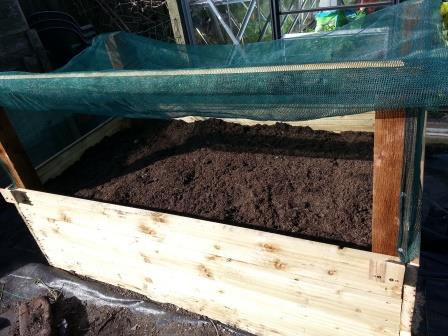
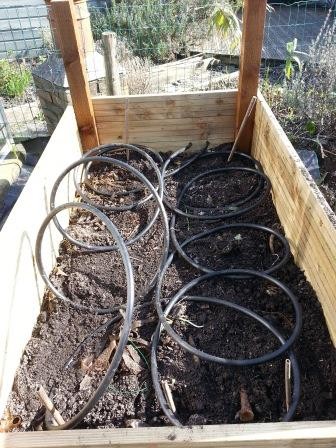
I constructed the bed from decking boards and fence posts, it is roughly 6ft x 3ft and the posts stand high enough to support protective netting. I part filled the bed with surrounding topsoil, then a mixture of worm compost and seaweed. Above this I laid a coil of hose pipe, threading each end through holes drilled through one of the boards.

20140308_112341


Then the bed was filled with more soil /compost mix, and finally topped off with a layer of coir compost to try and deter slugs a little bit (this is actually the main reason for creating a raised bed, the more barriers the better).

20140404_115132

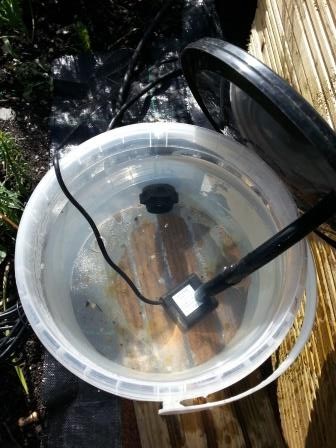
Then I created a small reservoir in an old plastic tub to hold the water pump.

20140404_115344

The final piece to the jigsaw was a coil of black hose, the type used in irrigation circuits, this was fastened to a black painted piece of thick plywood using cable ties and appropriately placed holes drilled through the wood, (much care needed, drills and hosepipes do not mix well). Once everything is tickety-boo this irrigation panel will be framed and covered with a piece of perspex, or even just clingfilm, to help trap heat inside.

20140308_135626

The finished bed

So far everything is functioning as planned. The pump is pumping when the sun is out and you can tell by the temperature difference between the in-pipe and the out-pipe of the solar heater that it is doing it’s job. It isn’t fantastic at the moment, but I know from previous experience that enclosing the heating pipe will make a big difference.

A word on air locks; the pump is quite small and though it should pump 160 litres per hour, I think it probably circulates much less due to the resistance of the pipes, but this isn’t a bad thing as a slow rate is best to warm the water on its journey round the solar loop. I had to prime the circuit by connecting it up to a hose pipe on mains pressure to blow out the air to start with, but now it looks like the pump is capable of pushing small air bubbles out into the reservoir bucket. I am monitoring this as I based my plan on an internet person’s experience of heating his swimming pool with a small solar pump like mine. He had problems with air locks, but his was a much bigger and more complicated circuit.

Why not use a solar syphon? A solar syphon is a very exact arrangement of pipes, like a sideways ladder that warms water, and as the heated water rises in the vertical tubes it pushes warm water out of the top and so draws cool water into the bottom. I have made these before, and whilst these are good for warming a tank of water, you would still need a pump to push the heated water around the bed, as there is not enough pressure generated from a solar syphon to force water through a few metres of pipe. This project is a simpler setup, with less components.

The idea of all of this is to cheat the seasons, like all chilli growers, and vegetable growers in general, even professional ones I, find that the spring months particularly are a time when there is always a need for more warm growing space than you can get your hands on, especially at night time. So my hope is that at that critical time, March and April, this bed will act as a heat sink and sit a few degrees higher than surrounding soil, and the warm sunny spring days, which are inevitably followed by a cold night will help to warm the bed to a point where spring vegetables get a head start. Lets hope for some good results. I will plot some temperatures over the next few weeks and see what a difference it makes. Time will tell.